Quantum Computing For Computer Scientists Pdf Download

Taking us to Other Places
'And so many books, and so little fourth dimension'. The belatedly Frank Zappa had some foresight with that one, didn't he? Because, information technology's truthful, books are a wonderful pastime (especially now during the lockdown). They take us to other places, other times. As a scribe myself, I tin can chronicle to that.
On the whole, the genre is irrelevant, though it does assist if there'south a story there, a narrative that can force you lot to turn the side by side folio when the lure of the piece of cake set up of Netflix and Amazon Prime number is only a button away.
Skilful stories stay in the mind forever:
Dostoyevsky's The Brothers Karamazov. Jack Kerouac's opus and Howl by one of my literary heroes, the poet Alan Ginsberg, take formed me in some way, at least with how I 'subconsciously' class my words.
In scientific discipline writing, too, there have been books that accept, well, changed me. As a writer with a humanities' bent, this may seem odd.
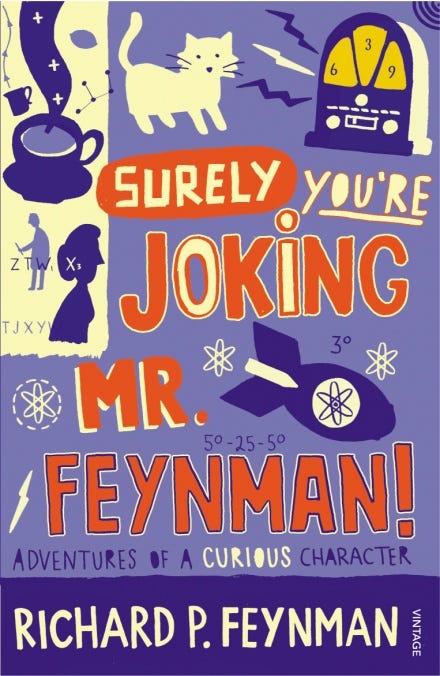
Stephen Hawking's A Cursory History of Fourth dimension, of course. Richard Dawkins' books. The astronomer Carl Sagan's backlist. The novel The Right Stuff past Tom Wolfe of Bonfire of the Vanities Fame —i of my best favourite novels set in the drug-fuelled, cash-excessive fourth dimension of greed that was belatedly 1980s Wall Street. And and then the Jewish joker with the 1965 Nobel Prize for Physics under his belt came into my life, showing the world what the Quantum could practice. Surely Yous're Joking Mr Feynman: Adventures of a Curious Character, written past his friend Ralph Leighton, introduced me to the very 'small' in my early twenties.
I was hooked… at to the lowest degree for a while. I studied a little more. It was also difficult. I gave upwards for a long fourth dimension.
Over the terminal few years, though, I started again on my quest to read books on quantum physics. The reason? I wanted to know what I didn't know.
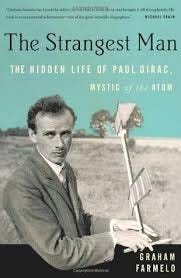
I read John Gribbin'southward In Search Of Schrodinger's Cat . The biography The Strangest Man: The Subconscious Life of Paul Dirac, Quantum Genius (which I loved!) QED: The Foreign Theory of Light by Feynman, as well every bit his lectures.
I understood and I didn't. I was the stupidest homo in the room and didn't care if I was. Here at TQD that is not an insult, it'south a compliment.
Nosotros are, like you, hither to learn.
The books listed below, which I take read in their entirety, were all a challenge bar one.
They span the theoretical implications of quantum calculating to programming, with smatterings of the history in the space, besides. They are also recent offerings published in either 2018 or 2019) with the exception of Scott Aaronson's book, as I thought such a disruptive industry equally QC needs publications as upward to appointment as possible.
Some are of better literary quality while others requite you the know-how needed to sympathise the more than demanding aspects of the industry. And the best ones, well, they just shine through regarding both mode and content, reaching the ultimate gold-mean.
So allow'southward start!
Quantum Computing for Everyone (The MIT Press) 2019
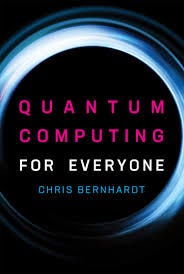
What better book to kick off the list than Chris Bernhardt'south Quantum Computing for Everyone , published in 2019 by The MIT Press. Bernhardt, a British professor of mathematics at Fairfield Academy, Connecticut, tries and succeeds in introducing the uninitiated to the foreign world of quantum computing.
Equally a mathematician by profession, information technology is surprising the man's grasp on breakthrough physics. In Chapter Two, though, Linear Algebra, the inevitable happens and the mathematician takes over with its number-heavy descriptions. Simply shy of 220 pages, the volume does a good job of making many of the concepts of QC accessible.
Bernhardt's volume is divided into 9 chapters:
— Spin
— Linear Algebra
— Spin and Qubits
— Entanglement
— Bong'due south Inequality
— Classical Logic
— Gates, and Circuits
— Quantum Gates and Circuits
— Quantum Algorithms
— Bear on of Breakthrough Calculating
Each topic is introduced 'conspicuously', in a prose that is 'maths/physics-heavy' though containing a fluidity that is both poetic and educational at the aforementioned fourth dimension. The author intentionally keeps the content 'accessible' for the non-specialist while nonetheless managing to educate at the same time. The simple black and white diagrams, which are generously dotted throughout the book, add together simplistic meaning to the opaqueness of the topic.
A bonus point.
[…] it should be emphasized that this book is most the theory of quantum computation. It is about software, not hardware.'
— Professor Chris Bernhardt, Quantum Computing for Anybody
Bernhardt, so, manages to eradicate some of the forbidding concepts of QC with a elementary stroke of his pen. Like a hero of mine, Richard Feynman, he 'humanizes' the bailiwick, altering the impossible — well — as in the title, for everyone.
Usually, I'thou browbeaten at first base by some of the articles on QC I've tried reading in publications like Quanta and New Scientist detailing some of the harder concepts of QC. Maybe it's science journalists or Ph.D. candidates trying to make a name for themselves via those portals, believing the more difficult they brand the idea they're trying to sell, the better they volition exist seen by the wider scientific audience.
And that may be true.
Complex symbols, numbers et al are few and far between in this book, though a caveat to that is some of the harder, nevertheless essential, theories of QC like Shor's Algorithm get skimmed over.
For those who have the book intending to become a basic run-through of QC, that is not an altogether bad thing. He views the new scientific paradigm as something that should exist attainable to all and everyone, not merely people like in his milieu.
Some would argue — and these are people with no mathematical or physics background at all, not even to high-school level — that the book'south title is not for anybody, though.
And peradventure they're right.
For those who have never heard of 'Dirac algebra' or 'Fourier transforms' and other 'basic' tenets of quantum physics, Quantum Computing for Everyone is going to be a hard slog. It is a superficial overview, simply rather one for a snotty-nosed undergraduate with enough education to know they're smart enough to know they don't know shit.
Quantum Calculating for Everyone, though an first-class book, is not 'for everyone'. Information technology's for the reader who has been on the QC journeying for at least a few years, a maths graduate from high school with a reasonable grasp of classical physics, an individual willing to go that extra mile to integrate their tech knowledge with a hereafter career in the infinite.
Dancing with Qubits: How quantum computing works and how it can modify the earth (Packt Publishing) 2019
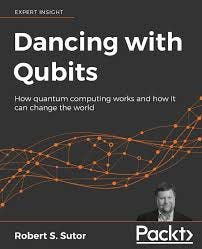
The next volume is Dancing with Qubits: How quantum computing works and how information technology can change the world by Robert Southward. Sutor, a homo who needs no introduction. Sutor, a mathematician by profession who gained a Ph.D. from Princeton Academy, has been a leading light in innovative industries for more than three decades, while for xx of those he has been working at IBM Research on several different areas of technology, including research on AI, the blockchain and mathematical computation. His all-time work, though, can exist seen in what he has contributed to QC over the terminal decade.
If you want to larn, so you lot should learn from the best, and there is no meliorate teacher than Sutor in the manufacture.
The first matter I should land about the volume is the introduction is as clear every bit it can exist, giving precise but simply presented information on the basic principles of mathematics and physics and how they correlate to quantum computing.
The book'south preface begins with the dandy Danish breakthrough physicist Niels Bohr's declaration that 'everything we call existent is fabricated of things that cannot exist regarded as existent.' It's a taste of things to come. Divided into two chief parts, 'Foundations' and 'Quantum Computing', which have their respective subsections including the aptly titled 'moving to two dimensions', 'the key functions', 'matrix algebra', and 'the breakthrough z gate', Sutor runs the whole gamut of theoretical implications and practical applications for QC in an easily accessible narrative.
Like Bernhardt's book, the author assumes the reader has primal cognition of the basics of physics and mathematics, at least to the level demanded by a first-year university pupil or a loftier-finish loftier school geek.
This book would be skillful as a coursebook equally well as for the student who prefers learning independently.
Blackness and white diagrams abound (there'due south even a photograph of Richard Feynman), clearing up, via visual models, some of the more difficult concepts.
If Sutor ever gets fired from his job at IBM, he could quite hands take upwardly a career as a writer. His manner is tight, entertaining and philosophically weighted while devoid of any of the patronizing bile that is common in many of the academic books and Ph.D. papers.
You can read Matt Swayne's review later on speaking with Sutor hither.
Quantum Computing: An Applied Approach (Springer) 2019
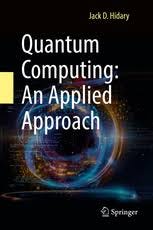
Some other book from 2019 is Jack D. Hidary'south Quantum Calculating: An Practical Approach , currently the best-selling book on Amazon on the listing. The author leads a team at Alphabet/Google focused on quantum tech and is a technology researcher and entrepreneur. The style is excellent just I feel, unlike Sutor'due south offer — or, in fact, the volume by Bernhardt — a lot of the data is too technical (this is not the author'due south fault, however, but the mine equally a reader). Yet so it should be, every bit it'south used in as a primary coursebook in masters and Ph.D. programs at the University of Waterloo and other universities.
Hidary, who studied philosophy and neuroscience at Columbia University, is at present focused on the nexus of quantum technologies and AI at Google. With a business career stretching back 20-five years, he's well placed to hash out all things futuristic. Additionally, he has given more than thirty lectures on quantum calculating at universities such as Oxford, Cambridge, Royal College London, Bristol, MIT, and Stanford.
Like in the other books, the preface and contents are presented clearly, too as the main thesis.
The 3 head chapters are divided every bit such: (I) Foundations (II) Hardware & Applications (3) Toolkit.
Sub-sections to these include 'binary and ternary operators', 'the Bloch sphere', 'breakthrough walks', 'tensor networks', 'the dot product', and 'bones prepare theory' are all well explained. Like the other books in the space, it is maths heavy but focuses on how QC can exist practical in today'south commercial world, which may attract readers with a business bent. This should have been expected from someone with as much sagacious entrepreneurship as Hidary. The book, then, makes a practiced accompaniment to the other publications on the marketplace.
For Stalk freshman with an enthusiasm for the coming tide of QC, this is essential reading. For the senior at college majoring in breakthrough physics with an internship at IBM or Honeywell adjacent summer, a great choice, too.
Quantum Computing since Democritus (Cambridge University Press) 2013

We come to old schoolhouse with our next book. 2013 is an age ago in terms of how QC has developed. At the time, the mural was pretty bare: startups similar D-Wave Systems, 1QBit and K Squared Lasers ruled the roost as far as startups went. IBM and a few others represented the big guns.
If anyone deserves the epithet of a 'quantum guru' these days– by that in terms of bookish credentials, social media influence and but the way he conveys the bulletin of quantum informatics — it has to be Scott Aaronson, professor at the University of Texas at Austin and former MIT faculty member. He is also the founding director of UT Austin's new Quantum Information Center.
But his acclaim in the industry doesn't stop there: his popular blog, Shtetl-Optimized, is gaining readers daily and is certain to be one of the go-to sources for all things quantum-related in the coming years.
So it is on the wave of this acclaim that we come to Aaronson'southward book Breakthrough Calculating since Democritus, at 404 pages one of the longer publications on the list.
The book is divided into twenty-ii chapters, each one written in a prose which is a please to read, even conversational in tone. For many, especially with a dry out scientific bias, this could be off putting. Not for this reader, though. It reminded me of the pace of a Feynman lecture: ingenious insight with a clownish tint. Ane thing I specially enjoyed well-nigh information technology was the titles to the chapters, from Chapter Ane's 'Atoms and the void', Chapter V'south 'Palecomplexity', Chapter Xviii'due south 'Fun with anthropic principle' to Chapter Twenty-2's 'Inquire me annihilation'. It shows the author has a sense of humour, as well equally a first-form scientific mind.
'The book is [also] likewise wide-ranging, breezy and idiosyncratic to be used much equally a textbook or reference work. Sure, it has theorems, proofs and exercises, and it covers the basics of an amazing number of fields: logic, ready theory computability, complexity, cryptography, breakthrough data, and computational learning theory, amid others…'
— Scott Aaronson, Preface to Breakthrough Computing since Democritus
While defective illustrations, Aaronson's unique ability to explicate hard concepts in QC is a treat.
Early chapters of the book are defended to logic, with a focus on Turing's legacy, the Completeness and Incompleteness Theorems of Kurt Gödel and all those other primal principles any self-respecting computer science student needs to know.
It is only later, more than than ane quarter through the book in the chapter 'Quantum' that — you guessed it — breakthrough gets a mention. This could be disappointing for those who wait information technology from the very first folio, only when it comes, there is no disappointment.
The usual suspects of quantum theory are mentioned: subconscious variables, decoherence, entanglement and fifty-fifty Hugh Everett Iii's astonishing many worlds/multiverse theory is given a spin. Stochastic proofs, besides, the intricacies of breakthrough algorithms and some meanderings into philosophy and cosmology in the after capacity give you a sense Aaronson doesn't desire to leave a stone unturned.
Or if that'due south not the instance, it's just his alibi to present the power of his intellect to the reader.
To summarize, and then, an excellent volume. A lot of computational complexity theory and maths to bargain with, and non for the average Joe, but if yous want to aggrandize your knowledge of QC while gaining an understanding of other related fields, Quantum Calculating since Democritus is an excellent starting point.
Quantum Calculating for Babies (Infant Academy) 2018
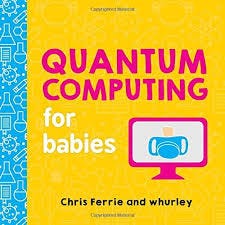
This adjacent one is but on my intellectual level. Written by honor-winning physicist and senior lecturer for breakthrough software and information at the Academy of Engineering science Sydney, Chris Ferrie — in collaboration with that QC evangelist and entrepreneur William 'whurley' Hurley — the board book Quantum Computing for Babies is a tour de force of simplicity explaining complexity. Function of a series of educational scientific discipline books by the author that includes Breakthrough Physics For Babies and Astrophysics For Babies, as in the title, it's written for babies/toddlers or those adults then intellectually impaired they don't know an atom from their behind.
Jokes aside, though, the short book gives a great summary of what QC is, describing in simple sentences with the help of colourful diagrams the difference between bytes and qubits. For young children, it'south a must.
Disclaimer:
By the end of the book, though 'adults' won't be able to solve 'the travelling salesman problem' someday before long, they volition have a fundamental grasp of what QC is. A truly educational book and an essential purchase for whatsoever parent out there who wants their progeny to get a headstart in the STEM subjects.
Quantum Computing for beginners: A Complete beginner'southward guide to Explain in Easy Way, History, Features, Developments and Applications of New Quantum Computers that will Revolutionize the World (self-published) 2020

Simon Edwards' Breakthrough Computing For Beginners: A Complete beginner's guide to Explain in Easy Manner, History, Features, Developments and Applications of New Breakthrough Computers that will Revolutionize the World was published in January of this year. Long in championship but brusque on content, at 165 pages, it's a slim work comparing it to others on the listing.
At present, before I go into the basic of the volume, one needs to detail — like I have done with all the other books so far — some biographical data on the author, Simon Edwards.
Unfortunately, at that place is none. Neither on the publisher nor the writer's credentials.
Not a trace.
He seems to exist the Thomas Pynchon of the QC globe. I had presumed before I purchased the 'free' copy on Kindle Unlimited it was a self-published endeavor. That doesn't usually put me off, especially with literature. I'm a partly cocky-published author myself and have profited well off it in the past (though not and then much anymore). When it comes to science books, however, my skepticism boots in.
Academics and popular scientists usually get through the well-tread channels of the university presses or 1 of the big five of Hachette, HarperCollins, Macmillan, Penguin Random House or Simon & Schuster.
Quality control is a must.
Simply I was willing to requite it a go, because, well, why not?
And it was FREE.
Edwards' volume is split into fourteen chapters, many of them posed as questions:
— What is Quantum Calculating?
— Are Breakthrough Computers a Reality or Merely a Scientist's Dream?
— Why Quantum Computing?
— How Quantum Computers Will Work?
Blah apathetic blah.
The volume, considering information technology'due south probably a DIY affair, is not a bad try at dissecting some of the harder issues of QC.
Although not on par with the others on the list (for obvious reasons), there is a clarity in the simplicity of presentation that is lacking in the books by the academics I have featured.
On a downwards note, a few typos and grammatical errors make the reading feel clunky at times but he who is without sin should read John viii:7 for a chip of enlightenment.
Programming Quantum Computers: Essential Algorithms and Code (O′Reilly) 2019
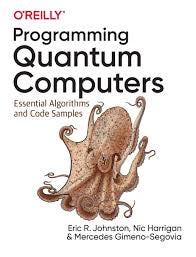
Co-authored past Eric Johnston, Nic Harrigan, and Mercedes Gimeno–Segovia, Programming Quantum Computers: Essential Algorithms and Lawmaking Samples gives you lot all the knowledge you need to program a quantum computer. At three hundred pages, it'due south a well-detailed publication giving you the ins-and-outs of programming a quantum estimator.
The authors' credentials are strong, lending weight to the volume:
Eric Johnston is a code optimization specialist. Education-wise, he has a B.S. in electrical engineering and informatics from U.C. Berkeley.
Nic Harrigan, meanwhile, has over 10 years' feel in the field of scientific discipline communication.
Mercedes Gimeno-Segovia, the appointed 'breakthrough brain' of the book, is a breakthrough physicist whose focus is the adjacent generation of breakthrough technologies. She gained her Ph.D. from Imperial College London.
This diverse publishing team, with its unique skill set, has its caput screwed on to the needs of the intermediate programmer by doing a corking task of explaining some of the key concepts of the field of study in a articulate and accessible way. Seeing as I'k neither a computer programmer nor a quantum physicist by profession, some of the more hard concepts were hard to follow without reading some passages multiple times.
'The heart of this book focuses on building an intuition for a set of breakthrough primitives — ideas forming a toolbox of edifice blocks for a problem-solving with a QPU.'
— Programming Quantum Computers: Essential Algorithms and Lawmaking
The volume is split into three parts:
— Part ane: Programming a QPU
— Part 2: QPU Primitives
— Part iii: QPU Applications
Graphic designer Rebecca Demarest supplies the professional illustrations and diagrams throughout the book, each one detailing visually the scientific hypothesis of what the authors are trying to convey.
To be honest, as long as y'all accept an IQ of over 110, understand Boolean algebra and gates and other 'entry-level' stuff, you should be well on your way as a pre-knowledge of quantum physics and high-level theoretical mathematics is not essential.
I recommend Programming Quantum Computers for those computer science majors wanting to explore QC programming as a potential next move in their careers. In that respect, there are few better on the marketplace.
Thanks for reading.
I really enjoyed it, though at times information technology was difficult to follow a lot that was going on. Quite a few weeks of hard slog, fabricated possible by the COVID-xix lockdown and my insatiable will to learn more near quantum computers and how they piece of work.
Equally we move into the third decade of the 21st century, TQD is sure QC volition play an ever more than important role in the technological landscape. And every bit it does, and every bit more people become qualified to talk nearly the space, more than books will be published: On the history of QC, on coding, on the hardware side of things and how breakthrough information science can work with business to optimize such spheres as the financial industry, logistics and pharma.
Attending: 2 more great books on the space, Seth Lloyd'due south Programming The Universe and Quantum Computers by Jon Schiller are covered in a post here from Quantum Multiverses. Delight feel complimentary to take await!
DOWNLOAD HERE
Posted by: christmonde1998.blogspot.com


0 Komentar
Post a Comment